Preface
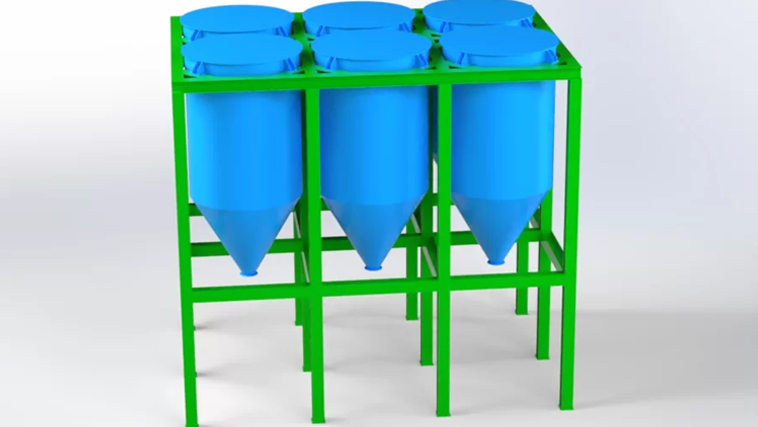
As standard supporting equipment for production lines, silos feature no complex transmission structures
and are thus often regarded as auxiliary machinery with low technical barriers, failing to receive adequate attention during engineering
design and type selection. However, once put into formal operation, malfunctions such as material blockage, caking and arching in silos will
continuously hinder the operation of the entire production line and drastically reduce production efficiency. It follows that refined silo design
is critical to stable and guaranteed production.
1.Material Storage: Its core function is to store and buffer raw materials and intermediate powders for bulk material stockpiling.
2.Process Connection: It separates front and rear equipment with disparate working conditions, connects intermittent feeding equipment
at the front end to continuous production units at the back end, and resolves conflicts in operating rhythms.
3.Production Capacity Buffering: It offsets capacity discrepancies between upstream and downstream equipment.
In most production configurations, the rated capacity of front feeding equipment slightly exceeds that of the main downstream units. Surplus incoming
materials are temporarily stored in the silo to balance capacity fluctuations and ensure uninterrupted operation of the whole line.
Conventional Design Specifications
The core objective of silo design lies in unobstructed material discharge. Structural parameters shall be determined based on the free-flow and cohesive properties of materials:
For ordinary powder silos, the hopper cone angle shall be controlled within 50° to 60° to realize gravity discharge by self-weight. For materials with excellent free-flow performance,
the hopper wall angle may be moderately reduced to prevent uncontrolled free flow and erratic discharge.
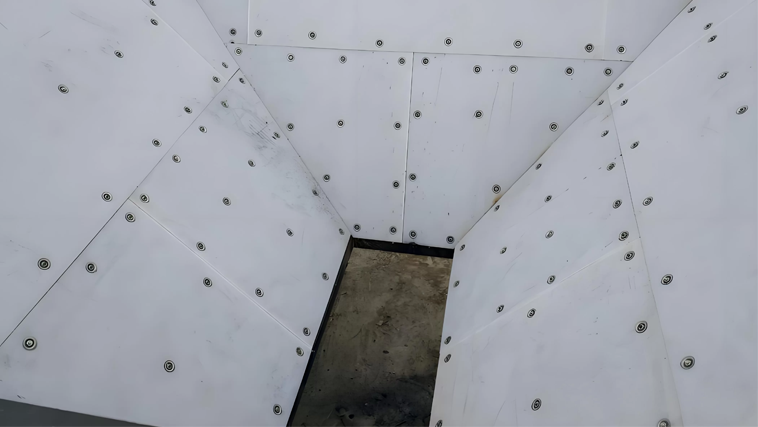
For highly cohesive materials prone to wall adhesion and material buildup, the inner silo wall may be lined with ultra-high molecular weight polyethylene sheets, thin 304 stainless steel plates or wear-resistant
polyurethane liners to lower the wall friction coefficient and mitigate material adhesion and caking (see attached drawings for structural reference).
Materials with strong cohesiveness that compact and cake easily shall be equipped with external vibration motors, air cannons and mechanical arch-breaking scraping devices. For working conditions with severe
caking and arching issues, a combination of multiple flow-aiding designs shall be deployed to sustain continuous and stable material discharge.
Conclusion
Silos may appear structurally simple, yet the key design points outlined above represent only a fraction of practical applications. There exists no universal template for silo design. Design work must involve rigorous analysis grounded
in on-site material characteristics and working conditions, and adopt site-specific solutions with a meticulous mindset to develop reliable silo schemes tailored to actual on-site operation requirements.